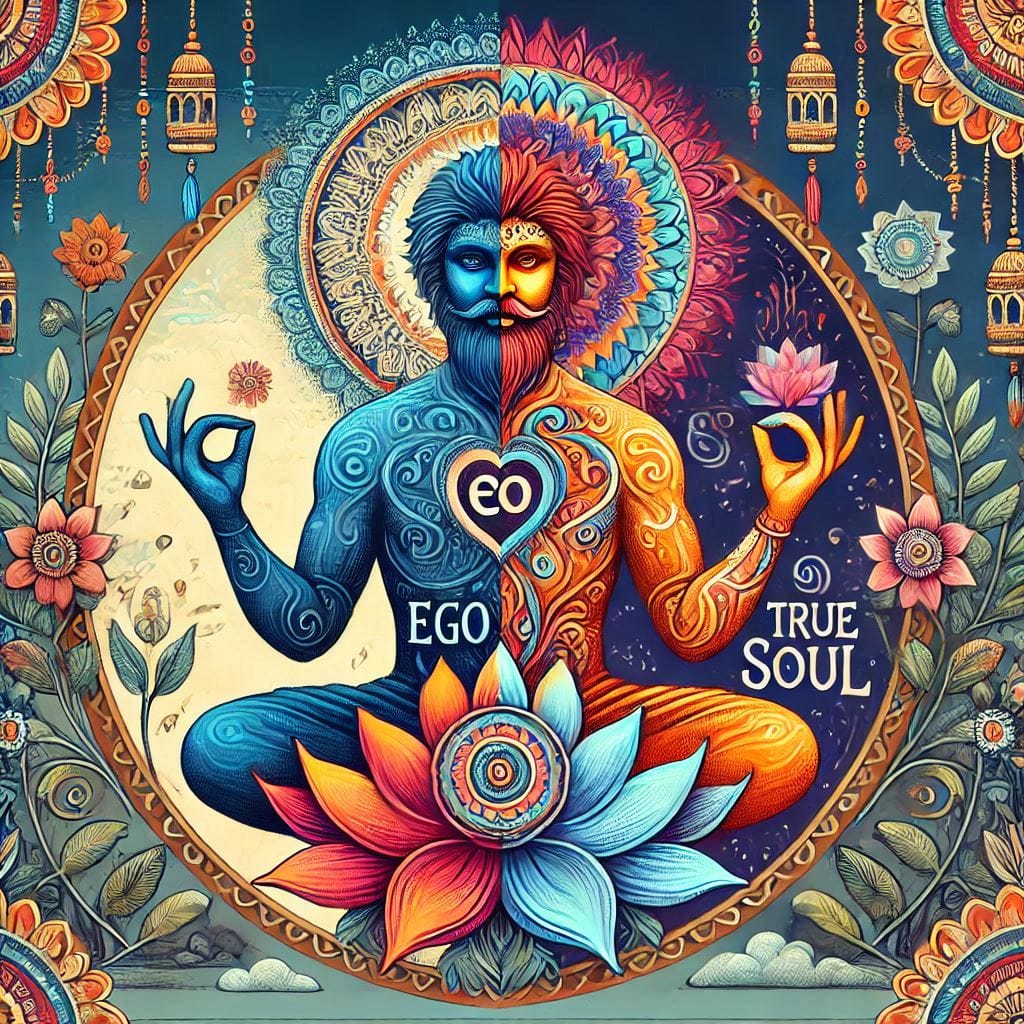
Freedom from Ego: The Two Birds Metaphor for the Soul

The story of “two birds perched on a tree” is in the third mundaka of the Mundaka Upanishad. It appears in the first section, Chapter 3, Section 1. It was given to explain the difference between the living entity and the divine. Our body is made up of several components. These include the mind, the ego, the five sense organs, the five karmic organs, and the panchkosha. These are all qualities of the body, not of our soul. When we realize that these elements are separate from our true consciousness, which is the soul, we achieve self-knowledge. This analogy of these two birds tries to convey a message. The soul is neither an enjoyer (bhokta) nor a doer (karta). It is only a seer.

We can understand this through this verse-
द्वा सुपर्णा सयुजा सखाया समानं वृक्षं परिषस्वजाते |
तयोरन्यः पिप्पलं स्वाद्वत्यनश्नन्नन्यो अभिचाकशीति ॥ १ ॥ (Mundaka Upanishad 3.1.1)
‘Two birds bound one to the other in close friendship, perch on the self-same tree. One of them eats the fruits of the tree with relish, while the other looks on without eating.’

A wonderful analogy has been given in the Mundaka Upanishad, which reveals the deepest mysteries of life. It gives an example of two birds that live on the same tree. These birds symbolize the ego (false ‘I’) and the divine (true ‘I’) within us. This analogy shows that our ego can trap us in a cycle of happiness and unhappiness. Meanwhile, the true soul stays in a state of peace and balance.
The Ego and the Divine: The Analogy as Two Birds

In this simile, the first bird symbolizes the ego, which is associated with the body and mind. This bird experiences all joys and sorrows. Just like the fruits of a tree, the ego sometimes experiences happiness. It also sometimes encounters sorrow. It sometimes encounters success and failure. This bird believes that it is the one who is experiencing all the ups and downs of life. But the reality is that the actions and consequences of the ego are not related to the real soul (Atma). The ego experiences only those physical and mental reactions that arise from our past actions.

The second bird is a symbol of God, which is pure consciousness. This bird lives only in the role of witness, without any attachment. It is a symbol of peace and balance, looking at every experience of life without any mental or physical effects. This bird has no charm, nor does it consider any fruit tasty or sour. It simply looks at every experience, but remains unaffected by it.

We can understand this by an example. If the image of the moon in the pond falls in still water, the moon’s image will be clear. It will be visible to everyone. If a pebble is hit in the same water, everyone will see a distorted image. But it will not have any effect on the moon. Similarly, the body aligns with the movement of the mind. However, it does not affect the soul.
Karma Fruits and Our Mental Experiences

In this metaphor, the fruits hanging on the tree symbolize the fruit of our karma. Our past karma, whether good or bad, manifests itself in various forms in the present life. But these fruits affect us only when we connect our identity with the ego. If we connect with external circumstances and mental reactions, we perceive ourselves as experiencing either happiness or unhappiness. But the true soul, which is God, is not affected by these karmic results. It is only the pure witness. The soul sees the experiences without any attachment. It neither assumes the taste of any fruit nor is it affected by any result. When we become connected with our true identity, we too can be free from these karmic fruits.

The Path Toward Peace and Joy. To break free from the shackles of the ego, we must recognize our eternal nature. This nature is the epitome of pure consciousness. We experience mental ups and downs, just like a person on an escalator can’t stop it from moving. This happens as long as we identify ourselves with the physical world. In this changing world, miserable birds will remain identified with their perverted nature. But if we connect with our true identity, we can come to a state of stability and peace. Therefore, if we connect with our eternal and unchanging identity, we experience peace and joy, unaffected by any external circumstances. We should avoid the ups and downs of life. We do this by connecting with our true identity—pure consciousness.

Conclusion: Choosing Between Two Birds. The essence of this analogy is a choice we must make. We have to choose between the ego (the false ‘I’) and the true self (the witness ‘I’). When we connect with the ego, we are influenced by the changing experiences of the physical world. We also learn to cope with suffering. But when we connect with our eternal, unchanging nature, we experience peace and joy. This analogy inspires us to recognise our true nature beyond the physical and mental attachments.
Reference
- Mundaka Upanishad Sankara Bhashya With Hindi Translation.(1935),Gita Press
- Mundaka Upanishad By Swami Chinmayananda English S D Shroff, New Delhi

Leave a Reply to Divyanshu PandeyCancel reply